
Machine CE Certificate
CE Certification According to 2006/42/EC Machinery Safety Directive
Under this directive, every machine must have a label carrying the CE mark and a CE certificate obtained in accordance with the requirements of the relevant directive. If fully implemented and tested according to Annex 1 "Essential Health and Safety Requirements" of the directive, machines can receive a CE certificate and affix the CE mark.
The manufacturer can facilitate the sale and free movement of machines both domestically and in the European market by providing CE certificates and test/inspection reports for the products they produce. The CE certificate/mark, which acts like a passport for the product in European countries, is very important for the manufacturer.
The high-risk machine groups covered under Annex 4 of the Machinery Safety Directive are listed below.
If the manufacturer produces any of these machines, they must obtain an "EC Type Examination Certificate" (also called AT Type Compliance Certificate). After meeting the necessary conformity requirements, the product is marked with the CE mark along with the notified body number that issued the Machinery CE certificate.
1 Circular saws of the following types (single or multiple blade) used for processing wood or materials with similar physical properties, or meat or materials with similar physical properties:
1.1 Saw machines with fixed blade(s) during cutting, having a fixed or supported bed, where the workpiece is fed manually or by removable power drive,
1.2 Saw machines with fixed blade(s) during cutting, with a hand-operated reciprocating saw carriage or table,
1.3 Saw machines with fixed blade(s) during cutting, having an integrated mechanical device for feeding the workpiece, with manual loading and/or unloading,
1.4 Saw machines with moving blade(s) during cutting, where the blade moves mechanically, with manual loading and/or unloading,
2 Planers for woodworking with manual feeding,
3 Thickness planers for woodworking with a mechanical integrated feeding device and manual loading and/or unloading on one side,
4 Band saw machines used for processing wood or materials with similar physical properties or meat or similar physical properties, with manual loading and/or unloading, of the following types:
4.1 Saw tables with fixed blade(s) during cutting, with a fixed or reciprocating bed or support for the workpiece,
4.2 Saw tables with blade(s) mounted on a reciprocating carriage,
5 Combined machines mentioned in paragraphs 1 to 4 and paragraph 7, used for processing wood or similar materials.
6 Tenoning machines with various tool holders for woodworking, manually fed,
7 Vertical spindle molders for processing wood or similar materials,
8 Portable chain saws for woodworking.
9 Presses, including press brakes, with manual loading and/or unloading, used for cold working of metal materials with moving parts having a stroke over 6 mm and speed over 30 mm/s.
10 Injection (spray) or compression molding machines for plastics, manually loaded or unloaded.
11 Injection (spray) or compression molding machines for rubber, manually loaded or unloaded.
12 Machines used in underground work of the following types:
12.1 Locomotives and decoilers,
12.2 Roof supports operated by hydraulic power.
13 Garbage trucks with compression mechanisms for collecting household waste, manually loaded,
14 Detachable mechanical transmission/drive assemblies and their housings.
15 Housings for detachable mechanical transmission/drive assemblies.
16 Vehicle maintenance lifts.
17 Devices for lifting persons or persons and goods with a risk of falling from a vertical height of more than three meters.
18 Portable cartridge-operated fastening machines and other impact machinery.
19 Protective devices designed to detect the presence of persons.
20 Power-driven, lockable movable guards designed to be used as protection in machines mentioned in paragraphs 9, 10, and 11.
21 Logic units intended to provide safety functions.
22 Roll-over protective structures (ROPS).
23 Falling object protective structures (FOPS).
How to Obtain a CE Certificate for Machines?
It is the responsibility of the manufacturer/importer to place the CE certificate and mark on the machine before marketing. The following methods are used by manufacturers to affix the CE mark on the product:
- Low-risk products: Many products fall into low-risk groups in terms of safety. The manufacturer declares conformity by issuing a declaration stating that the product complies with mandatory safety, health, environmental, and consumer protection standards. This declaration must be prepared in accordance with the relevant norms.
- High-risk products: The manufacturer's declaration alone is insufficient. These products must be tested by notified bodies. Upon approval by the notified body, the manufacturer can affix the CE mark on the product. Manufacturers of all systems and units produced for the final product provide files and declarations related to components and parts to manufacturers integrating them, in accordance with the directive. Part/component manufacturers cannot affix the CE mark on their products.
What Tests Must Be Performed Under the 2006/42/EC Machinery Safety Directive?
To obtain a CE certificate under the 2006/42/EC Machinery Safety Directive, a risk assessment must be carried out according to the EN ISO 12100 Standard. Many details from ergonomics to electrical control systems are examined in the risk analysis. According to Annex I "Essential Health and Safety Requirements" of the directive, a checklist must be prepared and inspection performed. The main machine tests are as follows:
EN 60204-1 Electrical Safety Tests
EN ISO 13857 Guarding of openings
EN ISO 13850 Emergency Stop Button Check
EN ISO 13849-1, EN ISO 13849-2 Control Circuit Inspection
EN ISO 4413, 4414 Hydraulic and Pneumatic Systems Checks
If applicable, type examination according to Type C standard.
What Happens If the Machine Does Not Have a CE Mark (Certificate)?
It is not possible to export, sell domestically in Turkey, or import from third countries to Turkey machines and equipment for industrial use without a CE mark (certificate) where CE marking is mandatory. The validity of the machine CE certificate is five years unless otherwise stated, provided the standards and directives remain current.
How to Affix the CE Mark on Machines?
The 2006/42/EC Machinery Safety Directive provides detailed information on how to place the CE mark on products. According to the directive, the machine manufacturer must obtain CE certification and affix the CE mark. The CE mark applies to:
- All new machines entering the market for the first time, whether the manufacturer is inside or outside the EU,
- Used machines imported into the EU and Turkish markets,
- Fully refurbished machines/equipment offered to the EU and Turkish markets.
What Are the Dimensions of the CE Mark on Machines?
The CE conformity mark consists of the initials 'CE' as shown below:
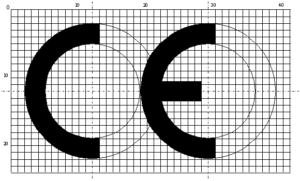
The CE mark is resized proportionally according to the shape shown in the image above.
The various elements of the CE mark should generally have the same vertical dimension, which must not be less than 5 mm. The minimum size can be adjusted for small-scale machines. For hand tools, the size of the CE mark may vary depending on the label size.
The CE mark must be affixed near the name of the manufacturer or authorized representative by the same technique.
How to Prepare the Technical File for CE Certification of Machines?
- Cover Page
- Table of Contents
- Information About the Manufacturer
- General Description of the Machine
- Name of the Machine
- Models
- List of Differences and Similarities Between Model Types
- General Machine Description
- Machine Images
- Calculations Related to the Machine
- General Operating Principle of the Machine
- Risk Analysis
- Technical Drawings
- Sample Labels
- Complete Parts List
- Safety Parts List (Electrical and Electronic Components)
- Performed Tests
- Applied Standards
- User Manual
- Appendices
- Declaration of Conformity
How to Prepare the Declaration of Conformity (Self-Declaration) for Machines?
The EC Declaration of Conformity must contain at least the following:
1) The trade name and full address of the manufacturer or authorized representative,
2) The name and address of the person responsible for preparing the technical file, who must reside in Turkey or the Community,
3) Description and identification of machines including model coding, function, model, type, serial number, and trade name,
4) A statement declaring direct conformity with the provisions of 2006/42/EC and, where appropriate, conformity with other relevant directives and provisions,
5) Where applicable, the name, address, and identification number of the notified body that carried out the EC type-examination and the EC type-examination certificate number,
6) Where applicable, the name, address, and identification number of the notified body that approved the full quality assurance system,
7) Reference to the harmonized standards used,
8) Reference to other technical standards and specifications,
9) Place and date of the declaration,
10) Identity and signature of the person authorized to compile the declaration on behalf of the manufacturer or authorized representative,
11) A copy of the notified body’s CE certificate.
İNTEGRAL guarantees to provide services with an expert team experienced in the 2006/42/EC Machinery Safety Directive. For information and offers related to 2006/42/EC Machinery Safety Directive, Machine CE Certificates, and tests, please contact us.
machine ce certificate